
The Regents Parrot (Polytelis anthropeplus) originates from Southwestern and southeastern Australia is not commonly kept as a companion bird.
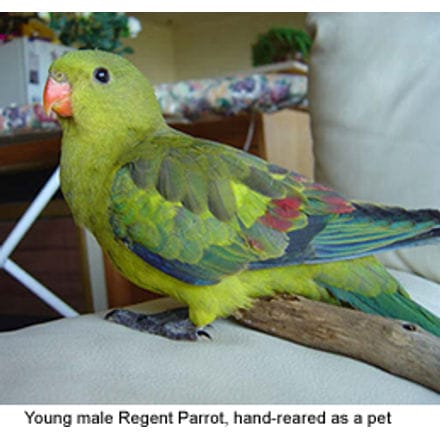
Hand reared male birds make the best pets and have a friendly and pleasing nature.
FREE Training to Stop Your Bird's Biting
Get FREE access to Beak School – the only system designed to train your bird. Stop behavioral problems like biting, screaming, feather plucking.
Get the Free TrainingThe striking golden colour of the male Regents Parrot makes for a very handsome pet and brings much joy to the owner. The Regents Parrot is easily tamed and very sociable. Like the Superb Parrot, the Regents possesses the ability to produce delightful whistling noises and to a small degree, imitate the human voice.
Talking Ability (compared to other parrots)
An occasional fresh willow or fruit tree branch to “spruce up” their quarters seems to please the birds. The Regent Parrot is naturally hardy, so being careful to protect them from drafts and the like is unnecessary. That said, however, they should be protected from excessive cold, as such is uncommon in their natural habitat.
| Chart and Some of the Info by: Dr. Rob Marshall |
| Regents Parrot Polytelis anthopeplus |
| Size: 40 – 45 cm (~ 16 inches) in length |
| Pet Status: Cock – Excellent |
| Talking Ability: Cock – Moderate |
| Noise Level: Low |
| Lifespan: 25 years |
| Breeding Ability: Excellent |
| Courtship Display: 2 weeks prior to entering the nest, Hen pesters cock for attention. |
| Number of Eggs: 3-7 eggs |
| Incubation: 21-23 days |
| Compatibility with other species: Good with other non-aggressive species |
| Feeding: Seed and Fruit eaters |
| Sexing: Surgical or DNA sexing prior to sexually maturity (2 years) is required. |
 |
Description:
Personality:
Fairly quiet parakeet; quickly confiding; hardy and tough. Particularly active in early morning and evening
Health:
They are susceptible to eye infections and feet problems (with fright and stress as causes). As they spend a lot of time on the ground they are more likely to pick up parasites. Therefore, it is recommended to worm regularly.
Physical:
The Regent Parrot grows to approximately 14½-16½” (37-42 cm) in length, and exhibits sexual dimorphism (meaning, males and females can be visually sexed).
The male bird is generally yellow, with several shades on the head; its back is generally a collection of colorful shades of green; its beak generally red.
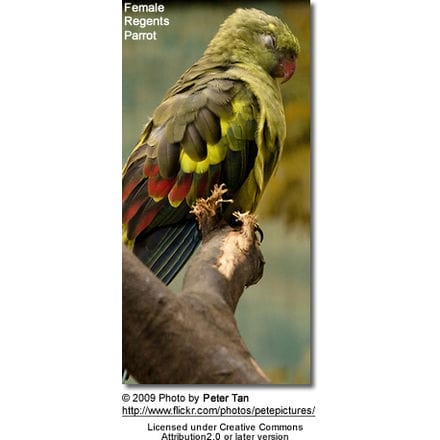
The female is generally more green, overall, especially in the head and body. The tail is green, although the underparts are black.
Breeding
In their natural habitat, the Regents Parrot typically nests in large, mature healthy trees with many spouts (though dead trees are used) close to a watercourse.
The female broods 3-7 eggs for approximately 20 to 23 days. The first clutch is occasionally infertile as female is often in condition before the male.
During the incubation period, the hen seldom departs from the nest, if at all, and is fed by the male. When the young have hatched, they are cared for by both the male and female. During this period, they can be fed several times their normal portion of feed, which they readily convey to their young. The young begin to fly at about 35 days and are independent at 50 days. Sexual maturity is reached at about 2 years of age. The Regents Parrot can breed twice a year. It’s, however, best to remove the young from the first breeding on the onset of a new breeding cycle.
The preferred nesting place is a stump with 20 cm (8 ins) interior diameter and at least 60 cm (24 ins) deep that is positioned diagonally. Alternatively, a nest box can be provided: 18 x 18 x 60 cm (7 x 7 x 24 ins) with entrance hole 8 cm (3 ins) in diameter.
Aviary notes by Dr. Rob Marshall:
FREE Training to Stop Your Bird's Biting
Get FREE access to Beak School – the only system designed to train your bird. Stop behavioral problems like biting, screaming, feather plucking.
Get the Free TrainingThe Regents Parrot is an excellent aviary bird and will live comfortably with other non-aggressive species. Aviaries should be a minimum of three to four metres long and one to two metres wide. When provided with adequate conditions and a suitable diet, there is no reason why most Regents Parrots will not breed.
Diet / Feeding
Captive Feeding: Regent Parrots thrive on chopped mixtures for large parrots. Various fruits and vegetables (particularly carrots, oranges and apples), as well as rose-hips and greenfood (chickweed, dandelion, spinach etc.) should be part of their diet. A high quality seed mix consisting of sunflower, wheat, oats, canary seed, various millets and weed seeds should be their base diet. They also like eggfood, sprouting seeds and a small assortment of insects. Insect softfood is particularly important during the breeding season and when raising the young. As with all birds, they need a ready supply of coarse grit to aid in digestion.
Natural Diet: Their principal foraging habitat are mallee woodlands, though foraging also occurs in riverine forests and woodlands. They may utilize cereal crops and will feed on spilt grain.
Care Requirements:
Please refer to the following websites for valuable information:
- Adopting or Purchasing a Parrot
- Optimal nutrition to keep your bird healthy
- Housing your bird
- Caring for your companion bird
Taxonomy and Other Data:
Genus: Scientific: Polytelis … English: Splendour Parakeet … Dutch: Prachtparkieten … German: Prachtsittiche … French: Perruche magnifique … Species: Scientific: Polytelis anthopeplus anthopeplus … English: Regent Parrot, Rock-Pebbler, Smoker Parrot … Dutch: Regentparkiet … German: Bergsittich, Olivgelber Sittich … French: Perruche à queue noire … CITES II – Endangered Species
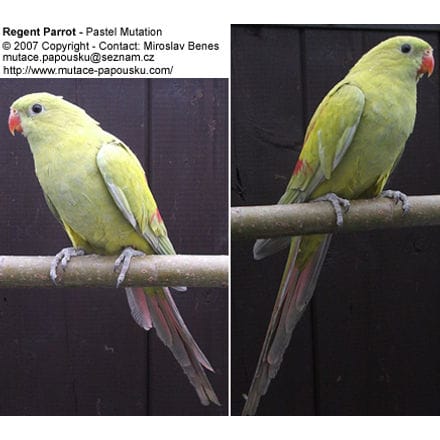
Description: They average 15.5 inches (40 cm) in length. The general plumage is yellow; the back is olive-green. They have a broad red band across the inner wing-coverts. The outer wing-coverts and tail are bluish-black. The bill is reddish and the eye-ring is grey. The irises are orange-brown and the feet grey.
Females have an olive-green head and breast. Her upper wing-coverts are olive-yellow with little red. Her tail is dark bluish-green. The underside has pink tips.
Young birds look like females. Young males attain adult plumage when they are 13 to 18 months old.
FREE Training to Stop Your Bird's Biting
Get FREE access to Beak School – the only system designed to train your bird. Stop behavioral problems like biting, screaming, feather plucking.
Get the Free TrainingDistribution: Native to the interior of southeast Australia.
FREE Training to Stop Your Bird's Biting
Get FREE access to Beak School – the only system designed to train your bird. Stop behavioral problems like biting, screaming, feather plucking.
Get the Free TrainingSub-species:
Distribution: They are native to Southwest Australia
Description: At 15 inches (38 cm) they are slightly smaller than the nominate form, Regent’s Parrot – anthopeplus – described and featured above. However, the head and the breast are a deeper olive-green. Females and immatures look like female Regent’s Parrots described above.
Genus: Scientific: Polytelis … English: Splendour Parakeets … Dutch: Prachtparkieten … German: Prachtsittiche … French: Perruche magnifique … Species: Scientific: Polytelis anthopeplus westralis aka Spathopterus anthopeplus – Note: justification for this sub-species is still much in dispute… English: Western Rock Pebbler … Dutch: Westelijke Bergparkiet … German: Westlicher Bergsittich … French: Perruche à queue noire de ouest … CITES II – Endangered Species
