
FREE Training to Stop Your Bird's Biting
Get FREE access to Beak School – the only system designed to train your bird. Stop behavioral problems like biting, screaming, feather plucking.
Get the Free TrainingRelated Web Resources: Ringneck / Long-tailed Parakeets … Ringneck Photo Gallery … Ringneck parrots as Pets (Behavior and Training)
Bookmarks on this page:

 Plum-headed Parakeets (Psittacula cyanocephala) are endemic to Sri Lanka (Ceylon), Rameswaram Island and most of India, as well as Rawalpindi in West Pakistan, Nepal east to Bhutan and West Bengal.
Their preferred habitats are the forest areas and open woodland. Populations undergo local movements, driven mainly by the availability of the fruit and blossoms which make up its diet.
Though this species is not exploited as heavily as the sympatric (of the same geographic region) Alexandrine Parakeet the trade takes its toll on local populations across the range. Population is reduced in urban areas and heavily inhabited zones.
Description:
This is a green parrot, averaging 13 – 14 ins (33 – 35 cm) in length, with the tail accounting for about two thirds of the length.
The male’s head is red, becoming purple-blue on the back of the crown, nape and cheeks. There is a narrow black neck collar and a black chin stripe. There is a red shoulder patch and the rump and tail are bluish-green, the latter tipped white. The upper beak is orangish-yellow, and the lower beak is dark.
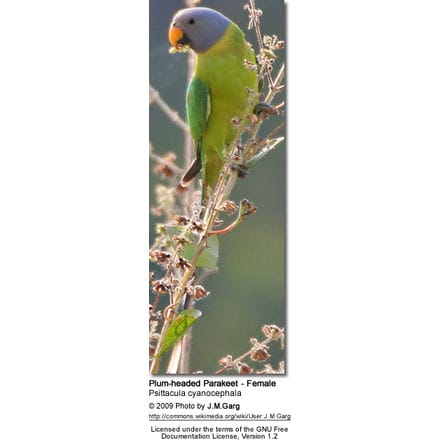
The female has a grey head, corn-yellow upper beak and lacks the black neck collar, chin stripe and red shoulder patch. Immature birds have a green head and both upper and lower beaks are yellowish.
The different head color and the white tip to the tail distinguish this species from the similar Blossom-headed Parakeet (Psittacula roseata).
Females attain the adult plumage at 15 months; young males attain full adult male plumage at about 30 months.
Similar Species ID: This species if often confused with the Blossom-headed Parakeet. The male Plum-headed Parakeet has a darker red head, while the male Blossom-headed Parakeet’s head is pink. The Blossom-headed Parakeets have yellow tail tips, while the Plum-headed Parakeet has white tail tips.

 The Plumheads as Pets

The Plum Headed Parakeet are popular pets. They are intelligent birds and many may learn to talk, although not as good as some of the larger parrots.
Most Plum-headed Parrots enjoy being close to their owner, however, they are not considered “cuddly birds” and don’t like petting.
As with just about all parrots, they are likely to be timid initially; however, given time, patience, and daily interaction, they should become tame quite easily.
These parrots tend to be more active in an aviary setting and may become apathetic in a cage environment. Their preferred environment should be an aviary, or a setting that allows them to fly and move around freely in a safe environment.
They do well in a communal aviary setting, getting along well with other birds — however, may be assertive to larger birds in the aviary.
Breeding / Nesting
Breeding Plum-headed Parakeets usually lay clutches averaging 4 – 6 eggs which they incubate for about 21 – 23 days.

FREE Training to Stop Your Bird's Biting
Get FREE access to Beak School – the only system designed to train your bird. Stop behavioral problems like biting, screaming, feather plucking.
Get the Free Training

Breeding:
In their natural habitat, the plum-headed parakeets nest in holes in trees. Plum Headed Parakeets produce one clutch a year.
These parakeets tend to be more active in an aviary setting and may become apathetic in a cage environment. Their preferred environment should be an aviary, or a setting that allows them to fly and move around freely in a safe environment. They do well in a communal aviary setting, getting along well with other birds — however, may be assertive to larger birds in the aviary.
The breeding season typically begins in April. The average clutch size is 4 – 6 eggs and the incubation period lasts from 19 to 23 days. The chicks will fledge at about 6 to 7 weeks of age. The females may become aggressive towards the males during the breeding season.
Ringneck Parrots are generally hardy birds. However, the following diseases have been reported in this species:
 Ringneck Parrots are generally hardy birds. However, the following diseases have been reported in this species:
- Polyoma
- Sarcocystosis
- Aspergillosis (fungal disease)
- Bacterial infections (pneumonia)
- Hypovitaminosis A
- Psittacosis
Relevant Resources:
Species Research by Sibylle Johnson

FREE Training to Stop Your Bird's Biting
Get FREE access to Beak School – the only system designed to train your bird. Stop behavioral problems like biting, screaming, feather plucking.
Get the Free Training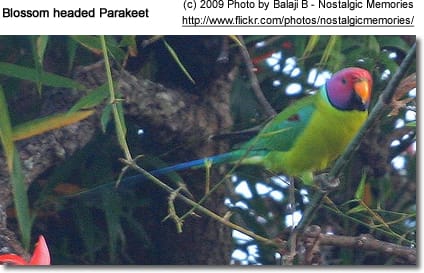
FREE Training to Stop Your Bird's Biting
Get FREE access to Beak School – the only system designed to train your bird. Stop behavioral problems like biting, screaming, feather plucking.
Get the Free TrainingTaxonomy
 Taxonomy
Species: Scientific: Psittacula cyanocephala … English: Plum-headed Parakeet … Dutch: Pruimekopparkiet … German: Pflaumenkopfsittich … French: Perruche à tête prune
CITES II – Endangered Species

Please Note: The articles or images on this page are the sole property of the authors or photographers. Please contact them directly with respect to any copyright or licensing questions. Thank you.
