Pet Macaws / Macaws in Captivity: Detailed Information & Photos
Beauty of Birds Editorial Team
September 16, 2021 · Updated January 28, 2025 · 9 min read
The author of this article is separate from the Beak School training courses and their instructors.
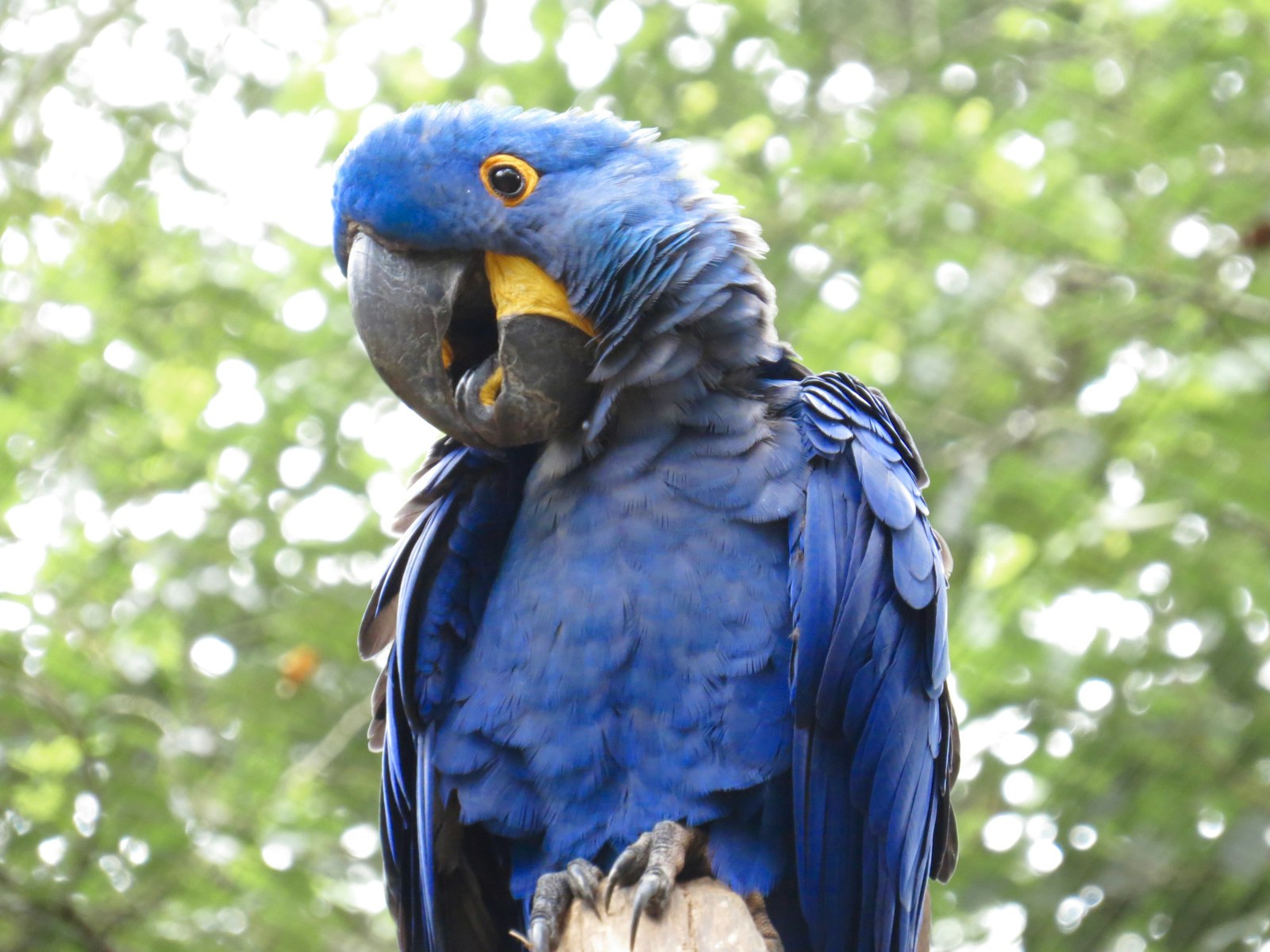
Photo: Jaime Dantas / Unsplash
Macaws are social creatures that form close pair bonds; therefore, they are ideally suited as pets provided their extensive needs are met. These powerful – yet delicate creatures – demand respect and require loving husbandry from their handlers.
Depending on the size, these active birds require large cages and the ability to move around freely in a safe, bird-proof home enviornment … Some of the larger species aren’t really suited for any cage at all and should be provided a large flight – indoor and / or outdoor, with a steady flow of new chew toys and other environmental enrichments to keep their smart minds occupied.
If they are allowed to roam around the house, one has to keep in mind that they like to gnaw and chew, and can easily destroy valuable household items.
Any space they are in, or have access to, should be carefully bird proofed.
A large variety of macaw species are available as pets, ranging from …
- The smallest of all macaws– the Hahn’s or Red Shouldered Macaw – at a length of about 12 inches (30 cm) – they are about the same size as a cockatiel; they are part of a group commonly referred to as “ mini-macaws“.
- One step us is the Yellow-Collared Macaw with a body length of about 15 inches or 38 cm. See how to care for your pet yellow collared macaw here.
- The larger Scarlet Macaw is both impressive in plumage details as well as size. They are about 33.5 inches or 85 cm long.
- The largest of all parrots – the mighty Hyacinthe Macaw. They are up to 1 meter (40 inches) long and weigh about 42 – 51 oz (1,200 to 1,450 g). They are rare and expensive, and in some areas, they are protected and licenses / permits are required to own them. This is the only member of the rare “ Blue Macaws” family that is available on the pet market.
Communication with their “flock” in the wild or with humans
Their vocalizations consist of loud, screeching and squawking calls and serve them to communicate with their peers in the wild.
They make contact calls with one another; they use their voices to define their territories and to warn family members of possible dangers. They also imitate sounds (including human speech) around them, often practicing on their roosting perches.
Even though their harsh wild calls can to some extent be “replaced” by verbal speech over time; their early morning or late afternoon vocalizations will never be completely “trained away.” They are natural to these animals.
Their voices are as important for them in their social interactions, as our own vocalizations are for us. This being said, their loud voices do present considerable challenges for their care takers. Other family members or neighbors may not be as tolerant as bonded humans might be.
## Longevity
Macaws have the potential of living 80 years or longer. This requires considerable commitment to their long-term welfare, including making arrangements for them for when we can no longer properly take care of them.
Macaws bond very deeply with their caretakers, who basically take the place of the lifelong mate these bird would have had in the wild.
They grieve deeply over the loss of their mate and being rehomed multiple times has the potential of causing physiological damage that cannot easily be repaired.
Not necessarily suitable for kids
Their strong beaks can cause considerable damage to small, curious hands. Even the friendliest macaw of all can get spooked and can bite if they feel threatened.
Oftentimes, there isn’t enough time for them to “think things through” and they will bite if something flashes in front of them or quickly comes towards them.
Children should only be able to interact with macaws under careful supervision of watchful adult eyes.
A macaw is not a bird for most households, but a source of great pleasure, wonderful companionship (and, admittingly, the occasional heartache over destroyed furnishings ;-), for the right owner.
Consider the following before adding a Macaw to your family:
- These are large parrots that require a lot of space — Are you able to provide an appropriate and safe space for this bird?
- These parrots can live up to 100 years. They bond for life — are you ready for a long-term commitment?
- Will you be able to provide daily, supervised time outside his cage?
- They are noisy and their voices are designed to carry over long distances. — will this be acceptable to family members and neighbors? These birds have an excellent talking ability, however constant training is also required to prevent this beautiful parrot from becoming excessively loud.
- Will you be willing to take time out of your schedule to give daily attention and stimulation to your parrot, play with him/her and train him to ensure that he or she doesn’t adopt behavioral problems? They show a large amount of intelligence in their behavior and require constant intellectual stimulation to satisfy their innate curiosity. They require an owner who is willing to provide the necessary stimulation, including providing lots of toys on which they can chew. Birds deprived of such toys often become very destructive, using their large, strong beaks to chew on their cage and other household items.
- Is the primary care taker a mature and responsible person who can adequately care for this complex animal?
Housing
Cage: The minimum cage size for one macaw would be 36 by 48 by 60 inches (~1 m x 1.2 m 1.5 m) with a minimum bar spacing of 1 to 1.5 inches (~2.5 cm – 3.9 cm).
A good flight / aviary size for macaws kept in a permanent outdoor aviary is at least 10 feet (3 meters) wide, 15 feet (4.5 meters) long and 8 feet (2.5 meters) tall.
They require a set-up that allows them to chew as much as they want, toys to keep them busy, an area that is easily cleaned and maintained.
Species Research by Sibylle Johnson
Further Macaw Information
- Macaw Information
- Photos of the Different Macaw Species for Identification
- Common Health Problems of Macaws
- Macaw Diet / Nutrition
Macaw – Detailed Information & Photos
Macaws have slim bodies, broadheads, and long, pointed, graceful tails that are as long as or longer than their bodies. They have large, strong beaks, which earn them a high degree of respect, and serve them well in opening even the hardest of nuts.
The Rare and Extraordinary “BLUE” Macaws!
These amazing parrots are either extinct or close to extinction. Successful conservation programs are ongoing to save the last of them …
In-depth research and BEAUTIFUL images of the “Blue” Macaws.
Macaw Licks
In the wild, parrots often flock to exposed riverbank clay licks (or “Macaw licks”) to ingest mineral-rich clay that benefit these birds in two different ways …
- Valuable, health-promoting nutrients are deposited in the clay on the river walls as water washes down the river bed.
- Natural detoxification: Macaws often digest unripe seeds and nuts and other food items with toxic compounds that are strong enough to kill other animals. The clay binds to these toxins and coats the bird’s digestive system, allowing these poisons to pass through their digestive systems without harming these parrots.
The locations of at least 120 known clay licks are known in the Amazon basin, where large flocks of parrots are found feeding. Some of the more accessible locations have become tourist attractions.
## Description
All macaws have slim bodies, broad heads and long, pointed, graceful tails that are as long or longer than their bodies.
They have large, strong beaks, which earn them a high degree of respect, and serve them well in opening even the hardest of nuts.
They have long, pointed wings that allow them to fly swiftly. In fact, they can reach speeds of up to 35 mph / 56 kmh. These agile and adapt flyers are able to navigate effortlessly through dense forests.
Variations exist in terms of size and plumage coloration, which ranges from green to blue, red and yellow.
Males and females look alike and either DNA (feather or blood) testing or surgical sexing is needed to identify the gender.
The young of most macaw species start out with grey or black eyes, which change to brown or yellow as they mature.
### The different macaw species vary greatly in size:
- the smallest macaw– the Hahn’s Macaw – is barely larger than a cockatiel, measuring only about 12 inches or 30 cm in length, including the long tail;
- the largest macaw – the Hyacinth – is also the largest of all parrots in terms of length and wingspan – averaging up to 40 inches (1 meter) in length. The flightless Kakapo is heavier, but not as long.
### Macaw’s Interesting Physical Adaptations:
- The tongue is dry, slightly scaly, and has a bone inside it – making it an effective tool for breaking open and eating food.
- The sharp, hooked bill is perfect for break open nut pods, and it is so strong that it can easily crush the hardest of all nuts and seeds..
- They have strong, zygodactylous feet with 2 toes pointing forward and 2 toes pointing backward (like woodpeckers) allow them to easily grasp food and other items, and bring items to their mouths for further exploration or for feeding, or they function to securely grasp the branches as they perch or move around in trees.
Macaws in Captivity / as Pets – Things to consider before adding a Macaw to your family
## Breeding / Nesting
Macaws are monogamous (forming pair bonds that last a lifetime) and even though pairs often join flocks outside the breeding season, pairs usually remain close to each other – except when one of them has to tend to a nest, eggs or young.
Pairs often engage in mutual preening or feeding when roosting in trees, and even in flight, they remain so close to each other that their wings are nearly touching. During the breeding season, nesting females typically incubate the eggs or take care of any nestlings, while the males will guard the area around the nest in addition to gathering and bringing food back to the nest to feed his mate and the young.
Breeding macaws in captivity ensures a steady flow of available captive-bred birds for the pet market, as well as making wild birds less attractive to poachers.
Macaw Behavior
These intelligent creatures are curious and ever alert, as they keep watch for predators. They are very social, spending a good amount of their days interacting with mates, family groups and flock members.
They typically sleep in the trees at night, and in the morning flocks of them fly to their favorite foraging places – often over long distances – to feed on fruit, nuts, insects and snails.
They use their beaks, tongues, feet and eyes to explore objects to assess their suitability as food, tools or toys. Macaws also spend a good amount of time chewing on wood to keep their beaks in good shape.
Most macaw species also enjoy water and are often observed splashing around in shallow puddles.
They make their presence known by their loud, screeching and squawking voices that are often heard in flight or when calling out to each other from their roosting places.
Most gain reproductive maturity when they are about 7 or 8 years old.
Macaw Training and Behavioral Guidance
Related Webpages:
Macaws: Training & Behavioral Guidance … Macaws as Pets … Hybrids … Macaws on the Endangered List or Extinct … Average Weights & Measures of the Various Macaw Species
Photos of the Different Macaw Species for Identification … Macaw Diet for Good Health / Nutritional Requirements … Macaw Diseases
Filed under: Pet Birds, Macaws
Watch the free parrot training videos.
Short, force free lessons from Beak School on biting, screaming, and building trust with your bird. Enter your email and start watching.
Ready to start now? Start my 14-day trial, $27
More on Pet Birds
8 Birds That Can Mimic Human Speech Almost Perfectly
Eight pet bird species that mimic human speech with stunning accuracy, and what their vocal learning means for training.
10 Best Birds For Experienced Bird Owners
If you’ve been a bird parent for years and feel ready to take on a feathered friend that matches your expertise, this article is for you. Today, we’re diving
Bird Feeder with Camera: Meet the Gigalumi Smart Bird Feeder
Imagine stepping outside and being greeted by an array of colorful birds, each chirping harmoniously, creating a serene backyard retreat.