
Living with a Lovebird (and other Pets):
Lovebirds have the fun personality of parrots, with the advantage of being more manageable due to their small, compact size.
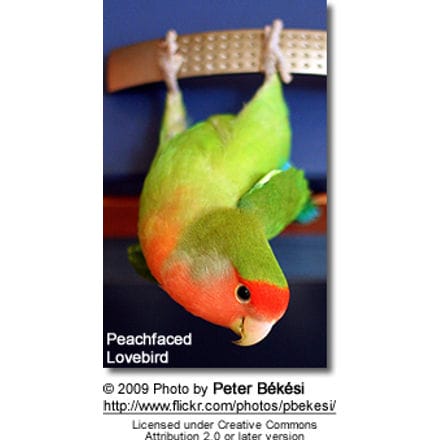
They are mostly known for their affectionate behavior towards their “chosen mate.” They love nothing more than “hanging out” with their bonded mate (which can be his or her owner, or another bird).
These little birds are truly devoted to their owners. This, however, may cause problems of jealousy towards other birds and other pets (including cats and dogs).
FREE Training to Stop Your Bird's Biting
Get FREE access to Beak School – the only system designed to train your bird. Stop behavioral problems like biting, screaming, feather plucking.
Get the Free TrainingThese brave little beings will not think twice about attacking other birds much larger than themselves, even cats and dogs — anybody indeed whom they perceive as rivals for your attention.
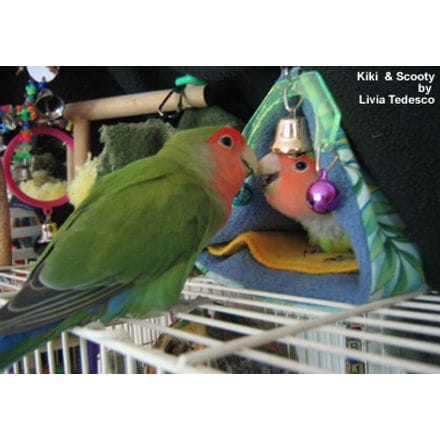
Most of them are true clowns, playing for hours at a time. They love hanging from their toys, resting in their birdie tents, riding on their owner’s shoulder.
Their most favorite place of all is usually their owner’s shoulder; snuggling up to his or her neck or hiding in their sweaters. When they get bored, they are likely to chew on clothing and jewelry, and pull off buttons.
So it’s best to protect your clothes when you have your pet with you.
- To save your necklaces / jewelry from being destroyed and to protect your lovebird from heavy-metal toxicities, I recommend against wearing any necklaces when your bird is with you. Instead, you may want to consider a “birdie necklace” made from bird-safe chains with small bird toys attached to the links – this will keep your pet’s attention off your clothing and, instead, they will play with the “birdie necklace” that you can carry around your neck.
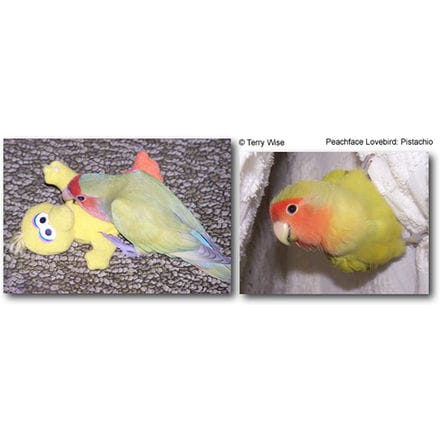
Lovebirds are “cuddly birds” and love to snuggle into their lovie-tent – that’s where they usually like to sleep. Lovebirds, and other “cuddly” birds – such as conures — just love these “retreats” …
If you are “handy,” it’s easy enough to make your own “lovie-tent” — I would probably use a thick and warm “arm” section from an old jacket or coat (fake fur interior would be ideal), and hang it up in his or her cage.
This would make a natural “tunnel” for him or her to climb into when sleeping time comes around.
Please make sure to finish it nicely, without hanging threads that he could entangle himself into and possibly get strangled – this actually happened with my lovebird’s mate.
Always look out for loose threads. I personally would put my life at risk handling a sowing needle 😉 and prefer to buy his tents. Each lasts a few years.
I would also recommend being creative in the way you furnish his cage. I have a coconut in Solei’s cage — with a couple of “lovebird-sized” holes in it for him to crawl into; and he loves that one too. You can also get baby toys at garage sales very cheaply. Many of them also make great bird toys!

Lovebirds as Pets:
Provided lovebirds are well socialized, they make wonderful pets. They do require just about daily socialization though. Don’t continue to ignore a lovebird and expect it to stay tame. That won’t happen.
It’s a great bird for someone who REALLY wants a cuddly bird and is willing to provide daily interaction to his / her pet.
It is difficult to tame an adult lovebird though, but if you come across a “throw-away” lovebird, please give him or her a chance. I have seen them develop into loved pets.
However, the easiest way is to get them young and handfed.
What Species of Lovebirds?
Well-socialized lovebirds generally make the best pets. In the past, I have bred and handfed both masked/eye-rings and peach-faces and my personal experience was that I had to spend MUCH more time with the eye-rings (which includes the masked and Fisher lovebirds) to get them tame – and after all that, they wouldn’t STAY tame.
As beautiful and cute as they were as babies, and notwithstanding the amount of time I spent with them — I was not successful in keeping any eye-ring lovebirds tame.
This being said, I have heard of several people with masked lovebirds as pets and they insist that their blackmasked or fisher’s lovebirds are wonderful pets.
So my disability to keep masked lovies tame may have been the specific family / genetic traits of the breeding pairs that I had at the time. The obvious dedication by masked lovebird owners seem to support that theory.
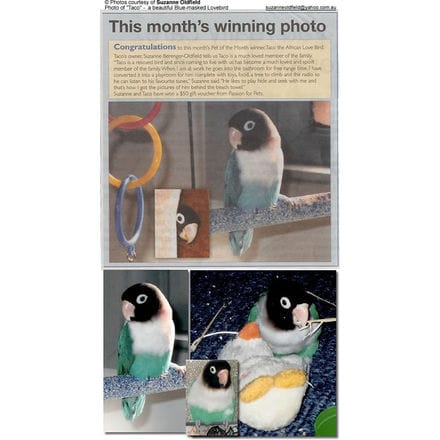
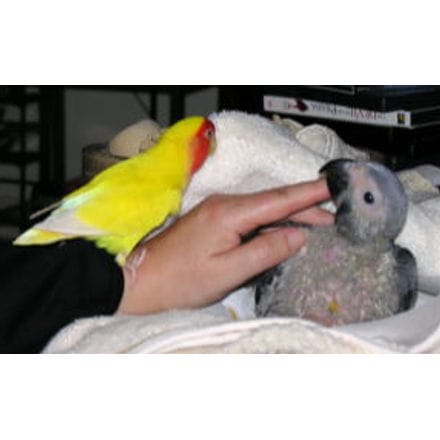
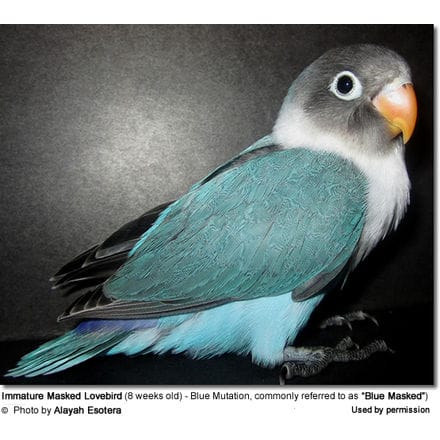
In fact, one web visitor sent me the below photos of her beloved pet blue-masked lovebird “Taco” who, to our deepest regrets, passed on recently.
Lovebirds and Other Pets in the Household:
I have owned cats, dogs and birds concurrently. I now have one handicapped cockatiel, Charlie — who lives on a tray and our cat has free access to him, and in many years has shown no aggression whatsoever towards him.
In fact, Charlie aka Cuddles flies off his tray at least once a day (whenever he gets spooked), and we find him on the floor when we come home after work — and have found that the cat would never hurt him. You can train cats and dogs to behave around birds.
If you are considering a mixed household, please visit this page on training your bird for information on how to do that.
I have trained quite a few cats (including feral cats). It is surprisingly easy. By the way, our cat is SCARED of our lovebird. Don’t tell anybody!
Lovebirds and Other Birds in the Household:
Many people believe lovebirds must be kept in pairs; however, I found this not to be true – provided you have time to spend with your pet.
A single lovebird tends to be a better pet because it is bonded with you rather than to another lovebird. However, if you have little time to spend with your lovebird, you may want to consider getting him or her a mate.
They are social birds and need interaction with another being. I found that they stay tame with you (provided you spend SOME time with him or her), if you manage to pair him or her up with another species.
I successfully paired my lovebird up with a cockatiel. It took some time of keeping them in adjoining cages and slowly allowing them to interact outside the cage.
But within a couple of months, they were a bonded pair — and BOTH remained tame and friendly with me!
Talking Ability:
Lovebirds rarely talk, but there is a chance they may learn to mimic human speech if taught to at a young age.
Housing
Lovebirds are very active and require an appropriately sized cage. They require lots of toys and things to chew on and play with.
Lovebirds are extremely social birds, and there is debate on whether they should be kept individually.
However, the consensus seems to be that they need social interaction, be it with their own species or a human companion, for their emotional as well as physical well-being.
Without this interaction, daily exercise, a roomy cage, and many toys to play with, they may resort to feather-plucking or other behavioral problems.
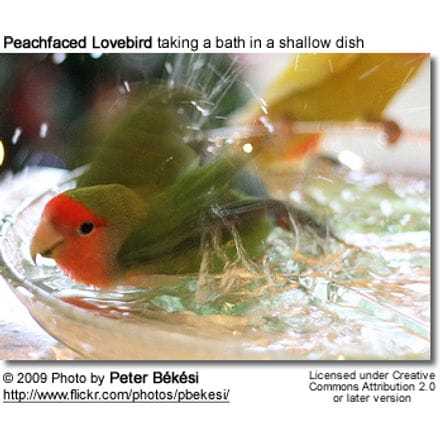
They love to take baths almost every day and may sun themselves after bathing in order to dry.
Potential Problems / Training and Behavioral Guidance:
Lovebirds are pretty easy to manage for most people. They are not as destructive and noisy as their larger cousins. If not properly socialized, however, they will discover their beaks as method of “disciplining us”.
It really is important to learn to understand them and to guide their behavior before an undesirable behavior has been established. There are few things to consider …
- Biting: If not properly socialized, however, they will discover their beaks as method of “disciplining us”. They can be very aggressive towards other animals (including birds), if they don’t know them or are jealous of the attention they are getting from their favorite human.
- Noise: Lovebirds are very vocal birds, making loud, high-pitched noises that can be a nuisance. They make noise all day, but especially at certain times of day.
- Chewing: As stated above, lovebirds are also very active, and love to chew things. When they are let out of their cage, it would be wise to watch them carefully, and protect any furniture, electrical wiring or anything else that they could possibly chew on. They are not big chewers – as their preferred medium is “paper.”
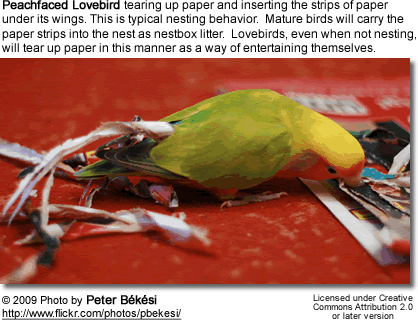
- Paper: They love to tear up paper — especially when they are in the “mating” spirit — which is all-year-round for birds kept indoors (not exposed to the seasons). I have learned not to keep important papers laying around – and even use it as a way to keep my lovebird busy.
Breeding
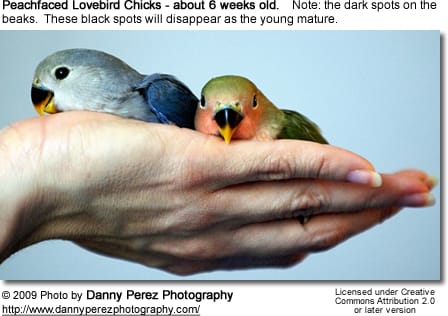
Lovebirds can start breeding when they are as young as ten months of age and may continue until they are five to six years. They are very prolific and may produce several egg clutches within a single year. Due to this, they are usually readily available on the pet market.
During breeding season the behavior between partners will change: the male displays a more aggressive behavior, while the female begins preparing the nest.
There are specific nesting boxes for lovebird-size birds, but if not available a cockatiel nesting box will do just fine.
FREE Training to Stop Your Bird's Biting
Get FREE access to Beak School – the only system designed to train your bird. Stop behavioral problems like biting, screaming, feather plucking.
Get the Free TrainingThe female builds the nest and lays three to six eggs, which are incubated for about twenty-three days. The nestlings are cared for by the female until they leave the nest at about six weeks of age. The father then takes over the feeding of the young for another two weeks or so until they are weaned.
Diet:
Lovebirds require a variety of food, such as high-quality pellets*, fruits, seeds, and vegetables. Birds cannot stay healthy on seeds alone.
Mine eats with me (from my plate – I do eat a healthy diet), as well has being served a good quality seed mix. I also buy an organic unfortified seed/nut mix for variety.
Better bird stores may also have high-quality bird mixes – similar to Dr. Harvey’s – so it’s a good idea to look around.
They also love millets and other healthy treats. Sprouts and fresh greens, such as spinach, are also extremely beneficial if not essential. *Please note: When feeding pellets to your pet, please be aware of the fact that overly feeding citrus fruits (including oranges) to your birds can lead to “Iron Overload Disease.“
More Lovebirds Information
- Lovebird General Information
- Lovebird Species
- Lovebird Diet
- Breeding Lovebirds
- Lovebirds as Pets
- Lovebird Diseases
Lovebirds – Detailed Information & Photos
Lovebirds are small African parrots that are named after the affectionate, strong, monogamous pair bonds they form with their chosen mate. However, the general perception is that lovebirds bond for life; however, “divorces” can and do happen in cases of established incompatibility.
Nonetheless, bonded pairs spend extended periods throughout the day and night snuggled up together, preening and feeding each other.
Lovebirds: The social and affectionate small parrots
Distribution / Range
Eight of the nine species come from Africa, the remaining one from Madagascar.
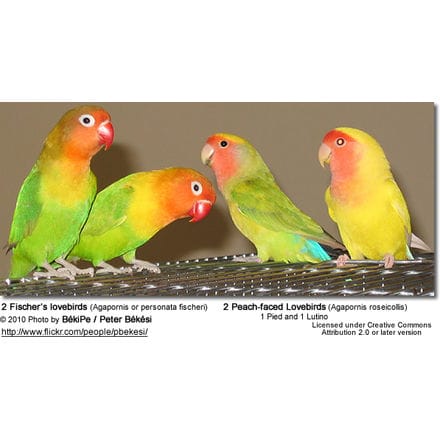
The most common species in the United States (and maybe worldwide) is the charming Peach-faced Lovebird – which have been bred in an array of beautiful color mutations. The striking-looking black-maskeds are also widely available.
FREE Training to Stop Your Bird's Biting
Get FREE access to Beak School – the only system designed to train your bird. Stop behavioral problems like biting, screaming, feather plucking.
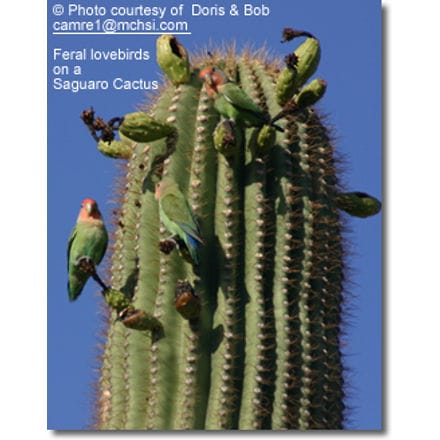
Get the Free TrainingNumerous feral populations exist in the United States (California, Arizona, Florida, etc.)
Lovebirds as Pets
These small parrots (sometimes also referred to as “Pocket Parrot”) have the intelligence and abilities of many of the larger parrots. They can also get quite bossy with other pets and even family members.
Their voice apparatus allows a wide range of articulations, including the imitation of the human voice. Although they are not known to be great talkers; and most never learn to talk at all.
If bonded to a human, they will make a very special pet indeed; ever loving as is true to its name. However, they do need a mate that spends significant time throughout the day with them – and in the absence of a bird mate – the bird owner has to fill this strong need for affection.
A pet lovebird that is given little attention is probably one of the saddest sights I can think of. On the other hand, poorly socialized or even abused lovebirds are typically very aggressive – and gaining their trust and love is very time consuming.
Not everybody is able to give this special bird the time commitment it needs.
They make lively and energetic pet birds. They are available in a variety of colors and are playful and often boisterous birds. They require an owner who is willing to provide the care and attention this animated bird adores. Birds that do not receive this attention become prone to behavioral problems, including feather picking.
Their lifespan is 10 to 15 years.
Description
They are small, stocky versions of parrots, with a short, blunt tail, and a large hooked upper beak.
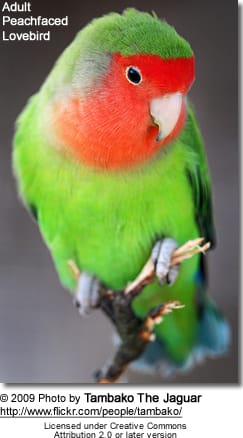
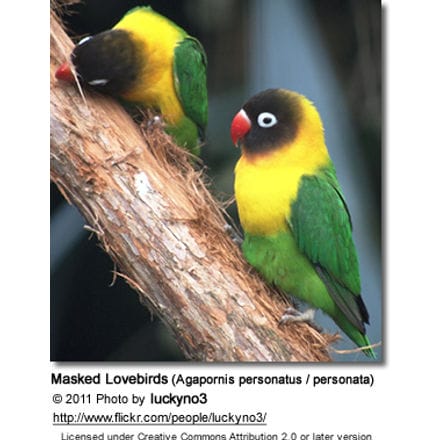
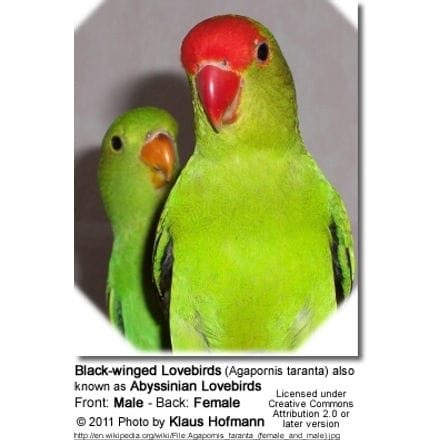
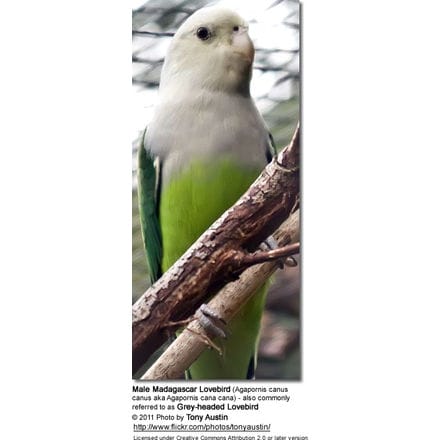
Those found in the wild are typically green with a variety of colors on their upper body, depending on the species. Some species, like the Black-masked, Fischer’s, Black-cheeked, and the yellow-collared lovebirds, have a white ring around the eye, although many color mutations have been developed in captivity.
They measure about 5 – 7.5 inches (13 – 19 cm) in length; and average 1.5 to 2.5 oz ( 40 – 70 grams) in weight, which puts them among the smallest parrots in the world. The Peach-faced is the largest lovebird species, weighing in at from 50-60 grams. Even though Abyssinian may be slightly longer than Peach-faces, they tend to be quite slender, and Peach-faces are typically heavier.
Gender Identification: In most lovebird species, males and females look alike and the only sure method of identifying their gender may be DNA sexing (or surgical sexing).
Once they have reached maturity (when they are about one year old), there may be behavioral indicators, such as shredding paper and stuffing the paper strips into its feathers (mostly female behavior – although some males also do it) or regurgitating for its owners (male behavior as the male typically feeds the nesting female) … More on lovebird sexing.
FREE Training to Stop Your Bird's Biting
Get FREE access to Beak School – the only system designed to train your bird. Stop behavioral problems like biting, screaming, feather plucking.
Get the Free TrainingThere are 9 species, of which 8 are commonly available as pets.
Aggressive Behavior with Other Birds and Animals
As loving and affectionate as these birds tend to be with their chosen mate (whether it’s another bird or a human), as aggressive they can get with those they deem to be intruders or competitors for their mate’s affection.
Their dominant and territorial nature can be a big issue with other pets — such as birds in the household, but even cats, dogs will be ferociously attacked. Because of this, their interactions with other pets should be supervised.
Even though they have been kept without too many problems in large communal settings, in cages they will fiercelessly compete for the space and are known to bite off the toes of other birds. In general, they should not be kept with smaller birds or even the docile cockatiels.
To minimize risk of injury or even death, lovebirds should be housed only with their own species with plenty of room for all.
Breeding:
The best breeding results is typically achieved when kept in a colony system (for some of the rarer species, this may not apply – please read up on the respective species pages).
A group of five or six pairs requires an aviary a minimum of three meters long (~10 feet) and one meter (~3 – 4 feet) wide. They may also be bred successfully using the cabinet system, where cabinets no less than 80 x 50 x 50 cm are (30 x 20 x 20 inches) recommended.
Hens build substantial nests and will spend a lot of time gathering twigs and other nest building materials from their surrounds. Check out this page for more information on breeding these birds.
Diet / Feeding
Their natural diet includes various fruits, vegetables, plant material, grasses and seed. Black-winged Lovebirds (also known as Abyssinians) also feed on insects and figs.
Black-collared Lovebirds have a special dietary requirement for native figs, making them problematic to keep in captivity.
Lovebird Diet: Proper nutrition for good health and longevity. (Please also refer back to the respective species pages for specific requirements, particularly when it relates to the rare species (listed above), which have some significant differences in nutritional requirements …
Class: Aves … Order: Psittaciformes … Family: Psittacidae … Subfamily: Psittacinae … Genus: Scientific: Agapornis … Dutch: Onafscheidelijken … German: Unzertrennliche … French: Inséparables … CITES II – Endangered Species

I have two lovebirds but I had to separate them as one lovebird
I have two lovebirds but I had to separate them as one lovebird was attacking the other. Is this normal?
Lovebirds can be very…
Lovebirds can be very aggressive. If the female is hormonal, she could kill the other lovebird she is caged with. keep them separated but in clear sight of each other. If your attacker, most likely the female, calms down put them back together but under your watchful eye. She may be ready to breed while the other is not, or you may have two of the same sex birds.
Is it a myth that you need…
Is it a myth that you need to keep love birds together. can we keep a happy healthy love bird by itself. Is it OK to have one love bird?
love birds are flock animals…
love birds are flock animals so do better with their own kind as does any flock bird.. not many people have enough time to devote to this beauty. I had a lovebird, she was aggressive and couldn’t be kept with another bird. Just because they are the same species doesn’t mean they will get along, so I don’t recommend getting more than one unless you have a separate cage for the second bird. There is always a chance they won’t get along.
In other words, it is absolutely fine to have one lovebird. However, because birds in general are “flock” animals, you will need to spend a good amount of time with the bird. When you’re home it would be nice to allow it free time out of its cage and hanging on you or cuddling in your hair or clothes, and spending a bit of quality time with it while you’re prepping meals (just keep it away from dangers such as boiling water, hot stove tops, or ceiling fans) or just sitting watching tv. You DON’T need to spend the better part of your day with the bird, but setting aside special times each day will be very beneficial to your relationship and keeping a happy bird.
If you work most of the day and the bird will be relegated to its cage (as it should when unsupervised), be sure you have a very spacious cage, and consider getting a lovebird playmate. In this case, I would suggest getting BOTH BIRDS AT THE SAME TIME so that they can share a cage from the get-go. They can be quite territorial so introducing a new bird to one you already have is tricky sometimes.
If introducing a new bird, you should have two cages and allow for slow, supervised introduction. You might even put the current bird in a new cage and let the new bird have the first (and hopefully larger) cage for a few weeks, so that it can establish a bit of its own territory in the larger cage while keeping the two cages nearby each other. After you feel sure they are playing and enjoying each other’s company, only then should you try supervised cage sharing.