
The Budgerigars (Melopsittacus undulatus, nicknamed budgies) are amongst the smallest parrots in the world – along with African lovebirds, the Asian Hanging Parrots, the Fig Parrots (from Australia and New Guinea) and, last – but not the least – the absolute winner as far as tiny size is concerned – the Pygmy Parrots from New Guinea.
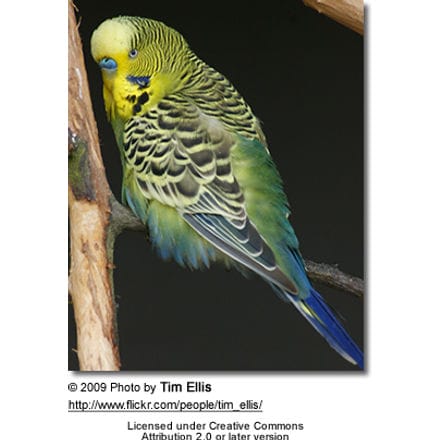
Live budgies have been imported into Britain for the first time in 1840, and they have been successfully bred in captivity since the 1850s. Their natural coloration is green and yellow with black, scalloped markings on the nape (back of the neck), back and wings. In captivity, numerous mutations have occurred with blue, white, yellow, grey and other colorations, and even birds with small crests.
Budgies have become the most popular and most common pet birds in the world – due to a combination of compact size, beautiful markings / colors of their plumage, playful nature, low cost and exceptional talking abilities.
FREE Training to Stop Your Bird's Biting
Get FREE access to Beak School – the only system designed to train your bird. Stop behavioral problems like biting, screaming, feather plucking.
Get the Free TrainingMale budgies, in particular, are considered one of the top five talking parrot species – alongside the African Greys, Amazon and Eclectus Parrots, and Ring-necked Parrots / Parakeets. Many favor the African Grey as the best mimic. However, the parrot with the largest vocabulary was a common budgie. According to the 1995 Guinness Book of World Records, a budgie called Puck officially became known as the bird with the most words. This talented little bird was able to speak 1,728 words.
Budgie enthusiasts have long recognized how very smart these parakeets are; and appreciate that they are far less troublesome than their larger cousins. This can also be to their detriment.
They are easy to keep and breed so well in captivity that way too many of them are available on the market and they are, therefore, terribly underpriced – resulting in them being considered by many as “throw-away” pets that are bought on a whim as toys for kids and are not considered to be worthy of quality care or costly vet visits.
There are so many unwanted / abandoned budgies that most rescue organizations won’t even accept them anymore…
Their closest relatives are the Ground Parrots (Pezoporus wallicus) and the Night Parrots (Geopsittacus occidentalis); and they are also related to Lories and Fig Parrots.
These colorful birds are native to Australia where they are naturally distributed throughout the continent; however, occurring more in the drier interior of the continent and the coastal areas in the far east and the far south-west.
This species is said to have survived in the inlands of Australia for over 5 million years.
Budgies favor open habitats and are commonly found in scrublands, open woodland and grassland, always near bodies of water.
Within their natural range, flocks of them generally migrate north for the winter; this seasonal movement is tied to the availability of food and water. Drought conditions can also drive them into more wooded habitat or coastal areas.
They have been introduced to many areas around the world including New Zealand, Japan, Europe, southern Africa, continental United States and Puerto Rico.
However, the only place were feral populations appear to have established themselves outside of Australia is west central Florida, USA, where they have been recorded in St. Petersburg since the 1940s.
However, their numbers in Florida have been declining probably due to competition with other birds (such as starlings).
These sociable birds are usually found in small groups and under favorable conditions in large flocks. As most birds, their activities begin just before sunrise with some movement within the trees, singing and mutual preening.
After sunrise, they fly to their foraging areas, where they feed throughout most of the day – except during midday or in extremely hot weather, when they typically rest in the shady canopy or other shaded location.
In the early evening, they return to their roosting sites for the night.

Distribution / Range
These colorful birds are native to Australia where they are naturally distributed throughout the continent; however, occurring more in the drier interior of the continent and the coastal areas in the far east and the far south-west. This species is said to have survived in the inlands of Australia for over 5 million years.
Budgies favor open habitats and are commonly found in scrublands, open woodland and grassland, always near bodies of water.
Within their natural range, flocks of them generally migrate north for the winter; this seasonal movement is tied to the availability of food and water. Drought conditions can also drive them into more wooded habitat or coastal areas.
They have been introduced to many areas around the world including New Zealand, Japan, Europe, southern Africa, continental United States and Puerto Rico. However, the only place were feral populations appear to have established themselves outside of Australia is west central Florida, USA, where they have been recorded in St. Petersburg since the 1940s. However, their numbers in Florida have been declining probably due to competition with other birds (such as starlings).
These sociable birds are usually found in small groups and under favorable conditions in large flocks. As most birds, their activities begin just before sunrise with some movement within the trees, singing and mutual preening. After sunrise, they fly to their foraging areas, where they feed throughout most of the day – except during midday or in extremely hot weather, when they typically rest in the shady canopy or other shaded location.
In the early evening, they return to their roosting sites for the night.

Budgies as Pets
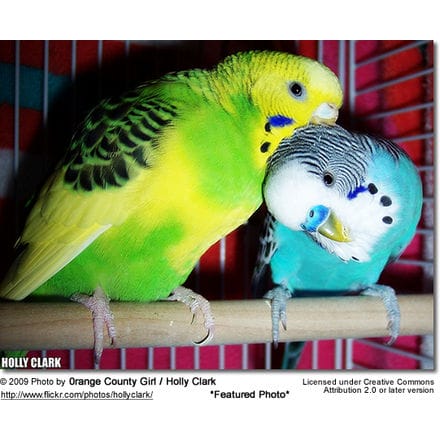
Budgies are amongst the most loved parrots around the world. They are smart, affectionate, and beautiful, and come in a wide spectrum of color variations and varieties.
Unless you have all day to spend with them, it is best to keep at least two of them, as they keep each other company and prevent them from getting bored and lonely.
If they are kept as pets (rather than aviary birds), daily interaction with humans is needed to keep them tame and friendly.
A common behavior is the chewing of material such as wood, especially for female budgerigars (probably linked to nesting behavior, as in the wild they will “customize” tree cavities with their beaks to best accommodate a family.
Even though they are far less destructive than their larger cousins, budgerigars, will also chew on wood and other household items to keep their beak trimmed. Chew toys / soft wooden pieces, mineral blocks and cuttlebone are good and healthier alternatives for birds to chew on than furnishings, which may have been chemically treated and are expensive to repair or replace. This may not stop them from chewing on household valuables though, and covering items up that birds have picked as their favorite chew toys is recommended. Blankets, towels, acrylic sheets usually do the trick.
These little jewels are thoroughly underpriced and therefore under-appreciated. They are often kept in tiny, boring cages that don’t allow them to get sufficient exercise and play, as they like to do. A cage should be accommodating several perches and toys, food and water dishes — in addition to leaving space for the budgie to fly from perch to perch.

Budgerigars can be taught to speak and whistle tunes. In fact, they are believed to be the best talkers of all birds. They can learn to pronounce hundreds of words and phrases. In fact, one California budgie is said to have had a vocabulary of 1,728 words by the time he died in January 1994.
Another budgie called “Sparky Williams” had a repertoire of 8 nursery rhymes, 360 phrases, and a vocabulary of over 550 words. In fact, this little budgie became a star and 20,000 copies of his records were sold by the time he died in 1962.
Males are generally more adept at a singing and mimicry. Females rarely learn to speak more than a dozen words.
They are intelligent and social animals and enjoy the stimulation of toys and interaction with humans as well as with other budgerigars.
These little jewels are thoroughly under-priced and therefore under-appreciated. They are often kept in tiny, boring cages that don’t allow them to get sufficient excercise and play, as they like to do. A cage should be accommodate several perches and toys, food and water dishes — in addition to leaving space for the budgie to fly from perch to perch.
Note: Budgies are known to cause “Bird Fancier’s Lung or Breeder’s Lung Disease” in people susceptible to this disease. People with respiratory issues may want to consider birds or pets that produce less dander / dust.
Budgies are quite entertaining, not as cuddly though as say a cockatoo or lovebird. But nonetheless, they make great “starter pets”:
Budgies are often given to kids as pets and neglected once the “novelty” wears off. Thousands of them starve to death or die from dehydration caused by empty water dishes. I strongly believe that if YOU don’t like birds, please don’t give one to your child as a pet, since in the end there is an excellent chance that you will end up as the primary caretaker.
FREE Training to Stop Your Bird's Biting
Get FREE access to Beak School – the only system designed to train your bird. Stop behavioral problems like biting, screaming, feather plucking.
Get the Free TrainingHowever, if you enjoy animals and love interacting and watching them – you are likely to form a wonderful relationship with one or two of these special little characters.
FREE Training to Stop Your Bird's Biting
Get FREE access to Beak School – the only system designed to train your bird. Stop behavioral problems like biting, screaming, feather plucking.
Get the Free Training
Training:
- Web Resources: Budgies are relatively easy to train and this website will provide valuable tips on parrot behavior and training.
Physical Description:
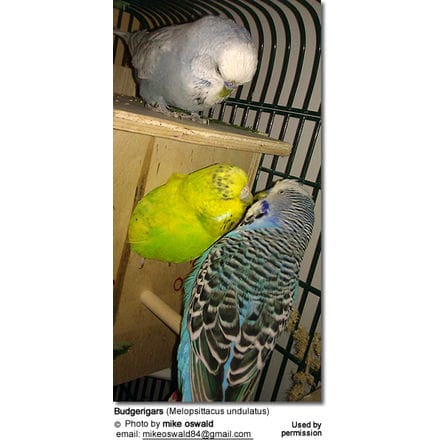
Budgies are generally green in nature, but breeders have produced them in myriad colors and shades, from white to turquoise to periwinkle. You can even find budgies that have a crest or curly feathers.
Size:
Length (including tail): 5.9 – 7.9 inches (15 – 20 cm)
Wingspan: 10 – 14 inches (25 – 35 cm)
Weight: 0.9 – 2.1 oz (~25 – 60 grams). Most of them weigh between 0.9 – 1.3 oz (25 – 36 grams.)
Notes: English “Exhibition” budgerigars are about twice as large as those found in the pet trade or their wild counterparts. Show birds not only have a larger body, but also puffier head feathers.
Plumage:
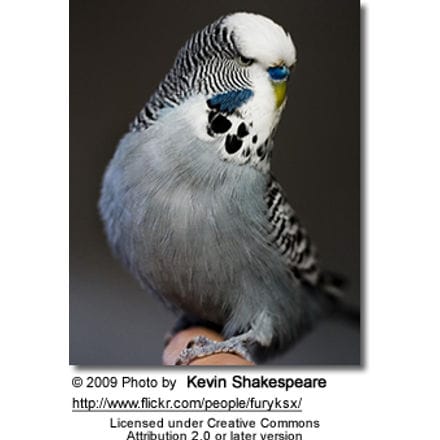
Wild budgerigars have green underparts and rumps, while the upperparts are barred with black and yellow. The forehead and face is yellow in adults, and barred black with yellow in young till they change into their adult plumage at 3-4 months of age. Each cheek has a small dark purple patch and a series of black spots across the throat. The tail is greenish blue or purple; outside tail feathers have a central yellow band. Their wings have greenish-black flight feathers and black coverts with yellow fringes.
Mutations
Legs:
Greyish blue, with zygodactyl toes.
Calls / Vocalizations
Budgies are very vocal and can be quite noisy – particularly if several are kept inside or in aviaries.
Listen to Sound Recordings

Adult males usually have dark blue ceres. Mature females have tan to brown ceres.

Identifying Gender and Approximate Age:
The color of the cere (the fleshy part above the beak) differs between the sexes and also changes as budgies get older or are indicators of the breeding condition they are:
Cere:
Adult Males (8 months +):
Breeding Male: Dark blue or purplish blue cere for normal varieties and bright violet or pink for inos (lutinos / albinos), dark-eyed clears, lacewings, fallow mutations and recessive pieds (danish pieds and harlequin).
Non-breeding Males: Pale-brown or Pink Cere
Adult Females (8 months +):
Breeding Female: Brown Cere (often with a ‘crusty’ texture). Some females develop brown ceres only during breeding time, which later returns to the normal color. Young females can often be identified by a subtle, chalky whiteness that starts around the nostrils.
Non-breeding Females: Beigish, White or Light Blue Cere
Young Budgies:
The cere is pink in both genders – however, immature males may show a purplish-pink hue. It is very difficult to sex budgies that are younger than 8 months because the cere has a tendency to change color.
Plumage:
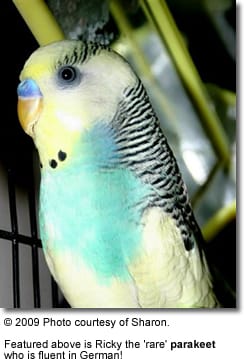
Applies to normal color varieties only … Budgies that are younger than 4 months will have a full head of cap feathers that are barred all the way down to the cere. At three to four months of age, the budgie will go through its first molt, and these cap feathers will be replaced by clear, non-barred feathers.
This does not apply for the color varieties Lutino/Albino and Recessive Pieds.
Behavior:
Males tend to be more vocal than females and have more variety in their songs. Females may be more aggressive than males. Males are often more active and outgoing.
Eyes:
- Young budgies (up to 4 months old) have all black eyes (irises).
- Budgies ranging from 4-6 months have dark grey eyes (irises).
- Budgies ranging from 6-8 months have light grey eyes (irises)
- Budgies ranging from 8 months and older have all-white eyes (irises).
NOTE: Exceptions to the above would be lutinos, albinos and recessive pieds. Dominant and recessive traits are also influence the color of the iris rings.
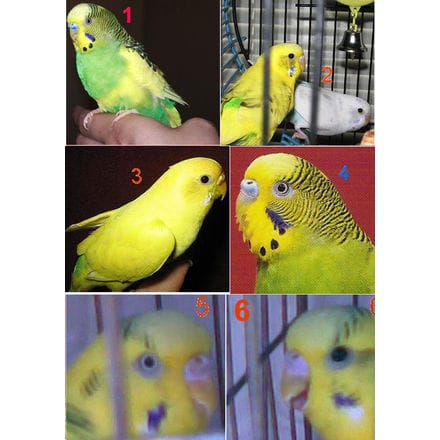
The below photos and information is courtesy of Ahmad, contact: tome.911 (at) hotmail.com – from Egypt
There are three kinds of eyes for parakeets.
Red Eyes: Yellow or white parakeets (albinos) have red eyes.
Black Eyes: The eyes are dark and the pupils are all black (photos 2 and 3).
FREE Training to Stop Your Bird's Biting
Get FREE access to Beak School – the only system designed to train your bird. Stop behavioral problems like biting, screaming, feather plucking.
Get the Free TrainingSunny Eyes: As can be seen in photos 1 and 4.
The eye has a black pupil and a white circle surrounding it.
In Ahmed’s aviary an anomaly occurred: one budgie with one black and one “sunny” eye.
Please refer to photos 5 and 6 — this is the same parakeet.
Diet / Feeding
Their natural diet consists of various seeds of grasses (spinifex and tall tussock grasses) and crop plants (ripening wheat); as well as eating some fruits, berries and green foods (leaves, buds, etc.). They will also take some insects, particularly during the breeding season when they have a higher requirement of protein.
They usually forage on the ground, de-hulling seeds and swallowing them whole or broken.
They like to bathe in shallow water and need to drink about 5.5% of their body weight daily – therefore, they typically remain near water.
Diet of captive budgies (aviary and pet birds).
Lifespan
Budgies can live up to 21 years. However, the average lifespan in captivity is 5 – 10 years. The life span depends on the budgerigar’s breed (the larger show / exhibition budgerigars typically do not live as long as the common budgies) and the individual bird’s health, which is influenced by genes, exercise and diet.
In the wild, they are only expected to live 3 – 6 years. The shorter lifespan is mostly due to predation by reptiles (including snakes), birds of prey, mammals (rats, etc.) and members of native tribes who hunt them for their brightly colored feathers for use in tribal costumes, as well as for food.
Alternate (Global) Names
English: The name “budgerigar” was derived from one of the native aboriginal names recorded by John Gould (an English ornithologist and prolific bird artist) – as ‘Betcherrygah’, which is believed to mean ‘good to eat.’ This name was then abbreviated to ‘budgie,’ a name commonly used today. In many parts of the world, they are also often referred to as “parakeets” – which is misleading since this term also refers to any of a number of small parrots with long flat tails.
Other earlier names of this species included Budgerygah, Canary Parrot, Grass-Parakeet, Lovebird (leading to confusion with the African Lovebird), Scalloped or Scallop Parrot, Shell Parakeet, Shell Parrot, Undulated Parrot, Warbling Grass Parrot and Zebra Parrot.
Catalan: Periquito … Chinese: ????, ???? … Czech: Andulka vlnkovaná, papoušek vlnkovaný … Dutch: Grasparkiet … Danish: Undulat … Spanish: Periquito Australiano, Periquito Común … Estonian: viirpapagoi … Finnish: Undulaatti … French: Perruche ondulée … German: Wellensittich … Irish: Budragár … Italian: Coccorito, Papagallino ondulato, Pappagallino ondulato, Parrocchetto ondulato … Japanese: sekiseiinko, Sekisei-inko … Lithuanian: Banguotoji pap?g?l? … Norwegian: Undulat … Polish: papuzka falista, papu?ka falista … Russian: ????????? ?????????? … Slovak: Papagáj vlnkovaný, papagájec vlkovaný, Papagájec vlnkovaný, papagájec vlnkovaný … Swedish: Undulat … Turkish: muhabbet ku?u, Muhabbetku?u … Welsh: Byji

Other Relevant Web Resources
Bird Care Requirements / Tips before Choosing the Right Pet for Your Family … Talking Abilities of the Budgie … Cages / Flights – Recommendations / Set Up Ideas … Bird Toys / Entertainment … Budgie Food

Why do people claim that…
Why do people claim that budgies are “easy pets”? I have one and he is definitely not easy to care for.
Because they think you can…
Because they think you can throw them in a tiny cage and expect them to thrive. People don’t understand that budgerigars are just as expensive as any other small parrot. They need interaction and exercise. It’s time consuming to take care of them properly.
They’re a commitment, and should be treated like a companion, not a centerpiece. I certainly would never call any bird an “easy pet.” Not if you’re caring for them correctly! It takes a great deal of time and patience to provide the correct food, toys, and mental stimulation a bird requires.
I would instead call budgies a good “starter bird.” A good way to evaluate whether or not having a larger pet bird is for you, or if you want to stick with the smaller ones. Remember Females, or older birds that were not hand raised will be more difficult. Learning how to tame and handle your budgie takes time and research.